7 days. 10–20 minutes a day. A written ending.


Swipe to see all 4 pages →
Maybe you haven't talked in weeks.
Maybe you already know it wasn't giving you what you needed.
Maybe you don't even want them back.
And yet, it keeps coming up.
A song brings back a conversation. A quiet evening brings back a question you thought you'd already answered. You remember how close it felt one day, and how distant everything became the next.
You reread a message you've already read too many times. You check a profile, then wish you hadn't.
And you're back to trying to make sense of it.
Was the connection real?
Did I miss something?
When exactly did things change?
Would it feel different if they finally explained?
Maybe it's not them you miss, exactly. Maybe it's that it never ended. It just stopped.
You don't need another conversation with them. You need a way to finish the one you keep having in your own head.
That's what this workbook is for.
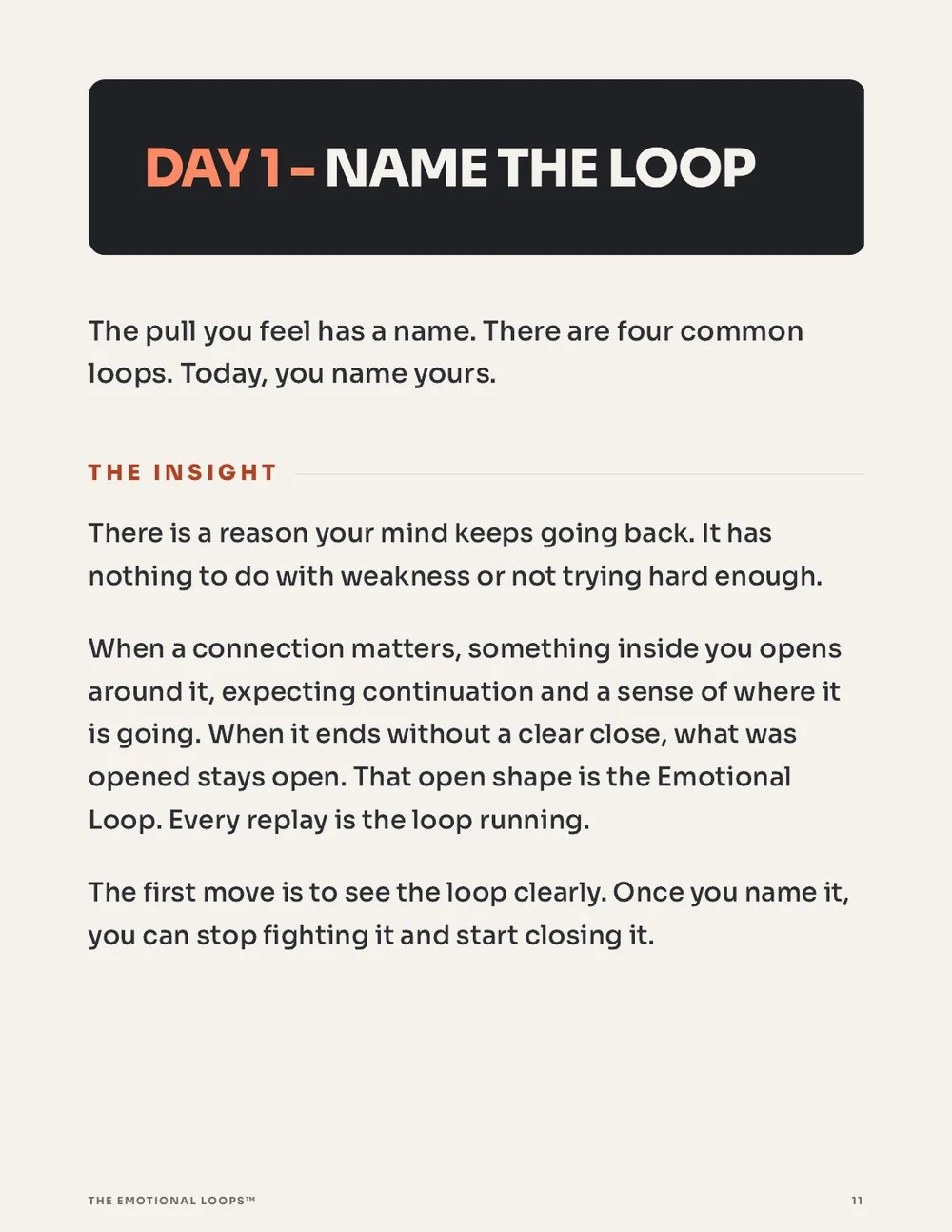
When something stops without a real ending (no answer, no last conversation, no reason), your mind keeps it open. Not because you're weak. Because an unfinished experience keeps asking to be finished.
That's an Emotional Loop.
Something opened and never got its ending, so your mind keeps going back to it.
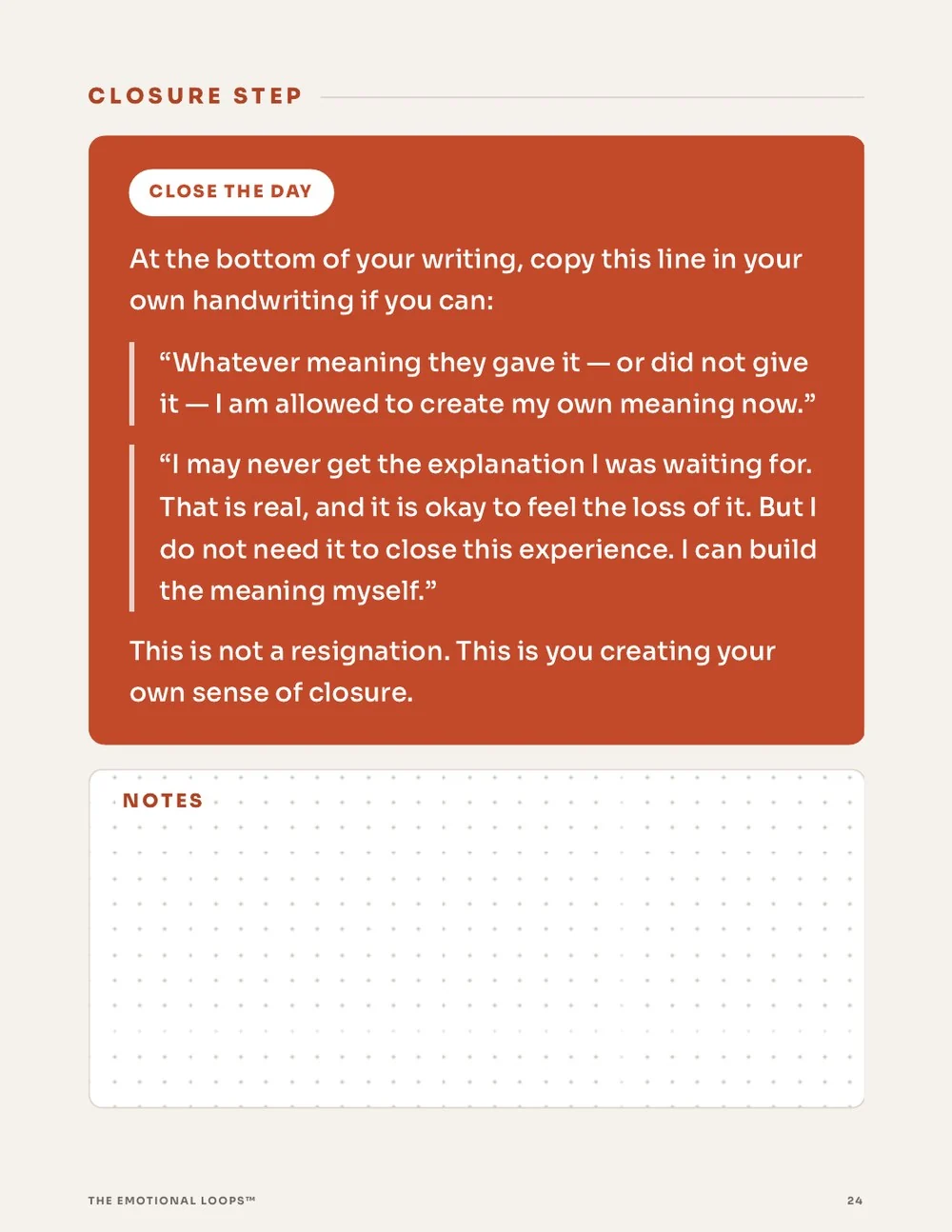
Something that tells your mind this part is done. Most of us wait for the other person to send it. Often, they never do.
A closing point you give the experience yourself, on your own terms.
The workbook guides you to write your own Completion Signal over 7 short days, so the ending no longer depends on anything from them.
When something ends without an explanation, it's natural to keep investigating the other person. But you can't write your way into someone else's head. Their full reasons may never be known.
The 7-Day Emotional Loop™ gives that work a structure: one focus a day, in an order that moves from what happened to a written closing point. No theories about their behavior. No pressure to stop caring.
Notice which thought or memory keeps pulling you back, and put it in one sentence.
The question, the conversation or the need that never got an answer.
Guided prompts help you write what has been hard to organize, including what you never got to say.
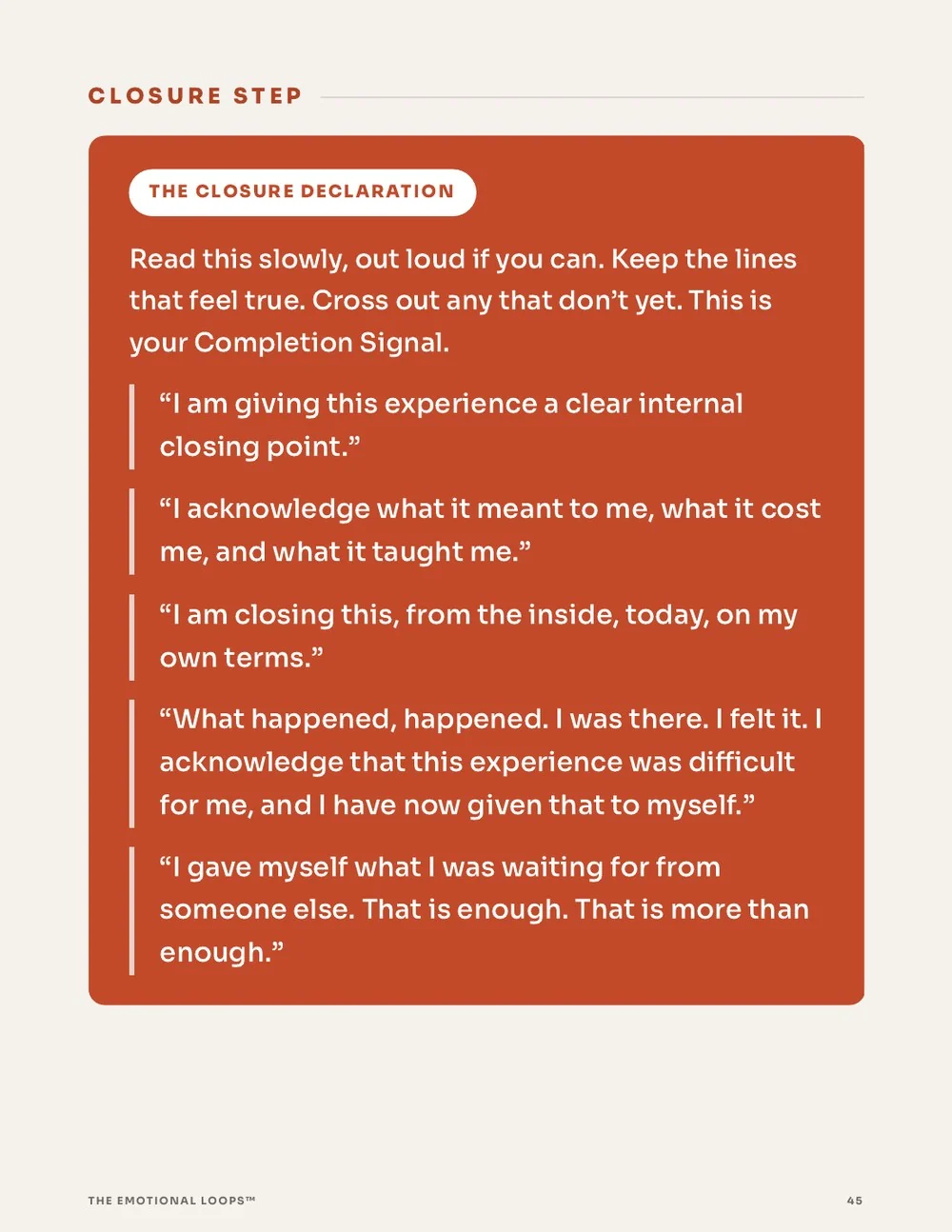
On Day 7 you write and read your Closure Declaration, and decide what you carry forward.
Part of you still wonders whether another message is coming. You get through the day, but you still check your phone, or rehearse what you'd say if they reached out.
It ended, but the explanation never came. You keep revisiting the same moments, wondering what happened and why.
It felt warm and certain at times, then distant and confusing at others. Now you're left trying to decide which moments to believe.
It was never official, so you feel you're not "allowed" to miss it. But the hopes were real, and losing an imagined future is hard to explain to anyone.
Everyday descriptions to help you recognize a familiar experience, not psychological labels. You don't need to fit a category to use the workbook.
You've probably tried some of these already. Each one helps a little. None of them gives it an ending.
Choose the experience you want to work on and notice what comes up when you think about it.
You leave with: one sentence that names why it keeps coming back.Find the conversation, question or unmet need that still feels significant.
You leave with: the exact moment your mind keeps returning to, written down.Look at the questions you've been asking and the meaning you've attached to what happened.
You leave with: the explanation you were waiting for, written from your side.Make room for feelings like disappointment, anger, longing or grief.
You leave with: names for what's underneath, and what you never got to say.Notice your reactions without forcing yourself to change them, at your own pace.
You leave with: the words you'd give a close friend in your place, given to yourself.Write everything you haven't had the chance to express. It's for you, and it's never sent.
You leave with: the unspoken, finally in words.Look back at the week and mark the experience in a way that means something to you.
You leave with: your Closure Declaration and your Seven Closing Points.Seven days give it structure. They aren't a deadline for how you should feel.
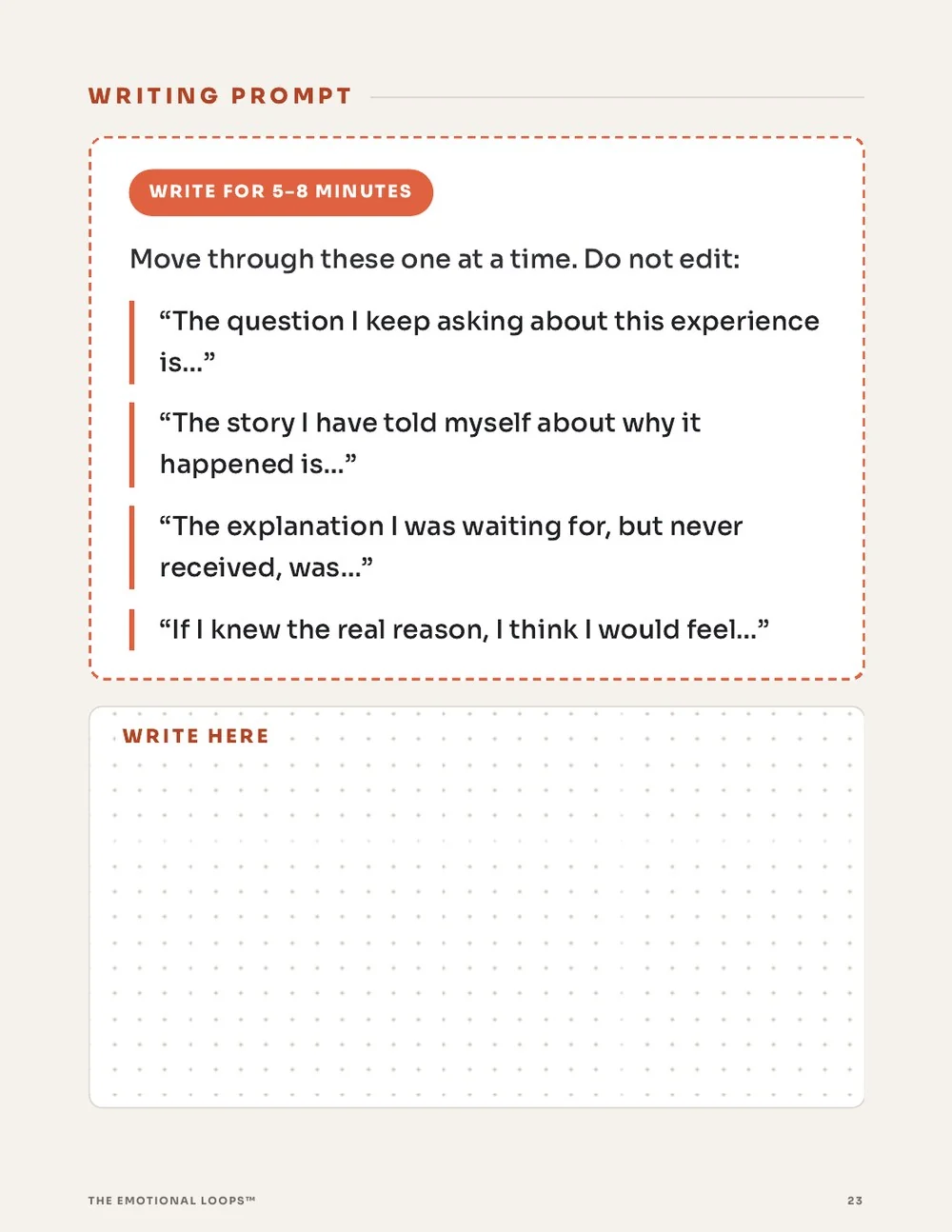
Each day gives you a few specific sentences to complete, in an order that moves from naming what happened to giving it a closing point. Here is one prompt from each day:
“My mind keeps returning to this experience because…”1 prompt
“The specific moment my mind keeps returning to is…”3 prompts
“The explanation I was waiting for, but never received, was…”4 prompts
“What I never got to say was…”5 prompts
“What I would say to a close friend who went through exactly this is…”4 prompts
The Unsent Message, then “What I see now that I had not fully seen before is…”3 prompts
“Apart from this experience, I am someone who…”5 prompts
Type straight into the writing pages on your phone, print them, or use your own notebook.
Where it comes from. In 1927, researcher Bluma Zeigarnik noticed that people remember unfinished tasks better than finished ones. Nearly a century of research since then has looked at what helps: short, structured writing, stepping back to see it from a little distance, putting unspoken words on paper, and small rituals that mark an ending. This workbook turns those ideas into 7 short days of writing.
Studies of expressive writing, including one with people after a breakup, link short structured writing to small but real benefits.
Lepore & Greenberg, 2002Looking back at a hard moment as an observer, instead of reliving it, is linked to less replaying.
Ayduk & Kross, 2010Expressing "unfinished business" to someone who isn't there is a long-standing exercise in emotion-focused work.
Paivio & Greenberg, 1995Research on rituals after a loss, including the end of a relationship, links them to a greater sense of control.
Norton & Gino, 2014Making a specific plan for an unfinished goal has been shown to make it pull less on your attention.
Masicampo & Baumeister, 2011These studies looked at general principles, not at this workbook. The 7-Day Emotional Loop™ is a self-reflection resource, not therapy, and it does not promise a specific result.
Here's a reflection based on an exercise inside the workbook.
“What feels most unfinished about this experience is…”
Take a moment to finish that sentence. Maybe it's:
Now this one:
“If I'm honest, what I needed and didn't get was…”
No perfect answer needed. Nobody else will read it. Just notice what comes up.
That's two prompts. The workbook gives you 25, in order, with an ending.

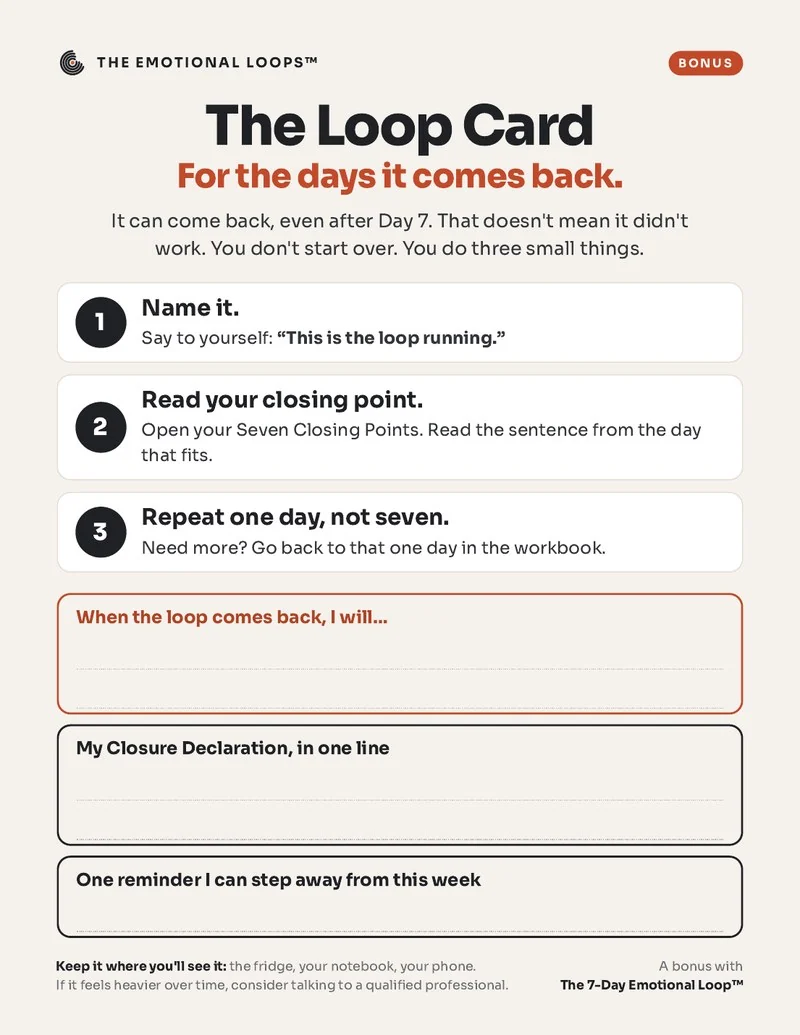
A printable page and a phone wallpaper with the 3-step plan for the days it returns: name it, read your closing point, repeat one day, not seven. Plus space for your Closure Declaration in one line, so it's where you can see it.
For a friendAfter you buy, email us your friend's first name and we'll send you a free gift link for her own copy of the workbook. One gift per order.
One-time payment. No subscription.
Yours to keep, print and reuse.
Work through it privately, at your own pace. Pause, skip, or come back to any exercise.
Seven short recordings, one for each day. Press play and a calm voice walks you through that day's reflection, reads your prompts with you, and closes the day with you. 4 to 8 minutes each, MP3 for any phone.
Do the seven days. If it wasn't worth your $27, email us within 30 days and get every dollar back. And keep the workbook and the Loop Card anyway.
No forms. No questions. One email to support@theemotionalloops.com from the address you used at checkout is enough. It covers the Audio Sessions too.
Nothing to return, nothing to delete. The only risk is on us.
The goal isn't to forget it or to stop caring, and no workbook can promise every thought will stop. Reflection runs on its own timeline. This gives it a structure and an end point.
I started The Emotional Loops™ with a simple idea:
Some of life's most confusing experiences don't come with clear endings. When that happens, people deserve a thoughtful way to reflect on what they've been through, without being told how fast they should move on.
That's what we build: self-guided resources for mixed signals, unanswered questions and connections that still feel unfinished. Clear, practical, and respectful of the fact that everyone's experience is different.
I don't believe a workbook should promise to erase someone's feelings or replace professional care. But I do believe reflection deserves more than a blank page and another piece of generic advice.
Sometimes the right question, asked in the right order, is a good place to begin.
— WahabFounder, The Emotional Loops™
You've probably already spent weeks thinking about this. Articles. Videos. Late conversations with friends. Notes on your phone. All of it without an end point.
This is one focused week, 10 to 20 minutes a day, that ends with something written. $27 one time: under $4 a day, and yours to reuse whenever it comes back.
Optional at checkout: The 7-Day Audio Sessions, +$17.
About 10 to 20 minutes. Each day has a short guided exercise and a few sentences to complete. Most days fit into one evening sitting.
Right after payment. Lemon Squeezy emails you the download link, usually within a few minutes. Check your spam or promotions folder if you don't see it.
You don't need a label to use this workbook. It works for an almost-relationship, an unclear connection, or any experience that still feels unfinished to you.
You can still reflect on your own experience. The workbook doesn't ask you to go no-contact, end anything, or make a decision about the other person.
The exercises help you explore the thoughts and feelings behind those habits, but no workbook can guarantee they'll stop.
This is far more structured than an empty journal: a specific question, a guided exercise and a closing step each day. You can try the sample reflection on this page before deciding, and you're covered by the 30-day refund either way.
No. The Unsent Message is optional. It's never sent, and you can skip it if it doesn't feel right.
No. The seven days give it structure, but you can move at your own pace.
After your purchase, email us your friend's first name. We'll reply with a free gift link you can forward to her. She gets her own copy of the workbook. One gift per order.
An optional add-on you can choose at checkout for $17. Seven MP3 recordings, one for each day, 4 to 8 minutes each. Press play, follow the reflection, then pause to write. They follow the workbook exactly, so you can use them or skip them on any day.
No. It's a digital PDF workbook in two editions: a phone edition with large, easy-to-read text, and a US Letter edition for printing. You can type straight into the writing pages in most PDF apps, or print them if you like writing by hand.
No. The 7-Day Emotional Loop is an educational self-reflection resource. It is not psychotherapy, mental health treatment, or a substitute for professional support.
Pause or skip it. If reflection causes significant distress, please consider reaching out to a qualified mental health professional.
You're covered by The 7-Day Promise. Email us within 30 days of your purchase and you'll get a full refund, no questions asked. You keep the workbook and the Loop Card. See the refund policy.
You don't have to pretend it didn't matter. You don't have to rush yourself into feeling differently. And you don't have to know exactly how to move forward today.
But you can give yourself one focused place to work through what happened, what it meant to you, and what you want to carry forward.
Not forgetting. Just finished.
P.S. You've already given this weeks of thinking with no end point. This is one focused week, 10 to 20 minutes a day, that ends with something you wrote yourself. And if it isn't worth $27, you get every dollar back and keep it all.